
Why Your Deepest Thoughts Do Not Require a Witness
The sanctuary of the unspoken

“Loneliness does not come from having no people about one, but from being unable to communicate the things that seem important to oneself, or from holding certain views which others find inadmissible.” — Carl Gustav Jung
We usually interpret Jung’s observation as a diagnosis of a problem. We read it and nod, recognizing the specific ache of sitting in a crowded room, quieting the urge to share a fascination or fear that the people around us, experience suggests, could find strange, intense, or even irrelevant.
The instinct, when we feel this variety of loneliness, is often to try harder to communicate. We caption ourselves. We attempt to explain the intricate parts of our inner world. We exhaust ourselves trying to find a graceful way, an intriguing way, to explain the complexity of a thought that is unlikely to be well met. We set it aside.
But there is a different way to hold the things that seem important.
The Exhaustion of Explaining
When we constantly seek external connection with our deepest fears and loves, we are treating our inner life like a museum exhibit that is failing because the visitors are confused. We scramble to write more detailed placards. We narrate our own experience, desperate for the nod of understanding that tells us we are real.
This is wearying. It is also often futile.
Some views are inadmissible to others. Some fears are too heavy for a casual dinner conversation. Some loves are too specific, too nuance-laden, to be transferred to another person’s nervous system.
But if there is no receptacle for these sparks from your flashing soul, where do they go?
You know that if you try to force these things into the shared space of communication, and they are met with blank stares or dismissal, the loneliness deepens. You feel as if you are giving away a piece of gold that somehow vaporizes in the process of sharing it.
The Arcane as Architecture
This dynamic is often most acute when we touch upon specific interests that we find compelling. These are the topics that seem to light us on fire but extinguish the conversation at a dinner party.
Perhaps you feel a genuine, lingering grief over the destruction of the Library of Alexandria. You mention it, hoping to share the weight of that loss. The people around you nod politely and change the subject. In that moment, you feel a distinct isolation. It feels as if you are the only person in the world who cares about those lost scrolls.
But this isolation is a mirage. You are rarely the only one. There are others who care. Yet even if you were the only one, the value of that interest does not vanish.
These specific fascinations are not trivia. They are the architecture of your character. The fact that you care about the Library of Alexandria, or the migration patterns of a specific bird, or the philosophy of the Stoics, is evidence of the uniqueness of your soul. It is a fingerprint. To dilute it for mass consumption is to lose the texture that makes you who you are.
The Treasure Chest
What if we stopped viewing this communication gap as a failure?
Consider the possibility that the views and the deep interests that arise deep within you are not burdens to be offloaded, but treasures to be guarded.
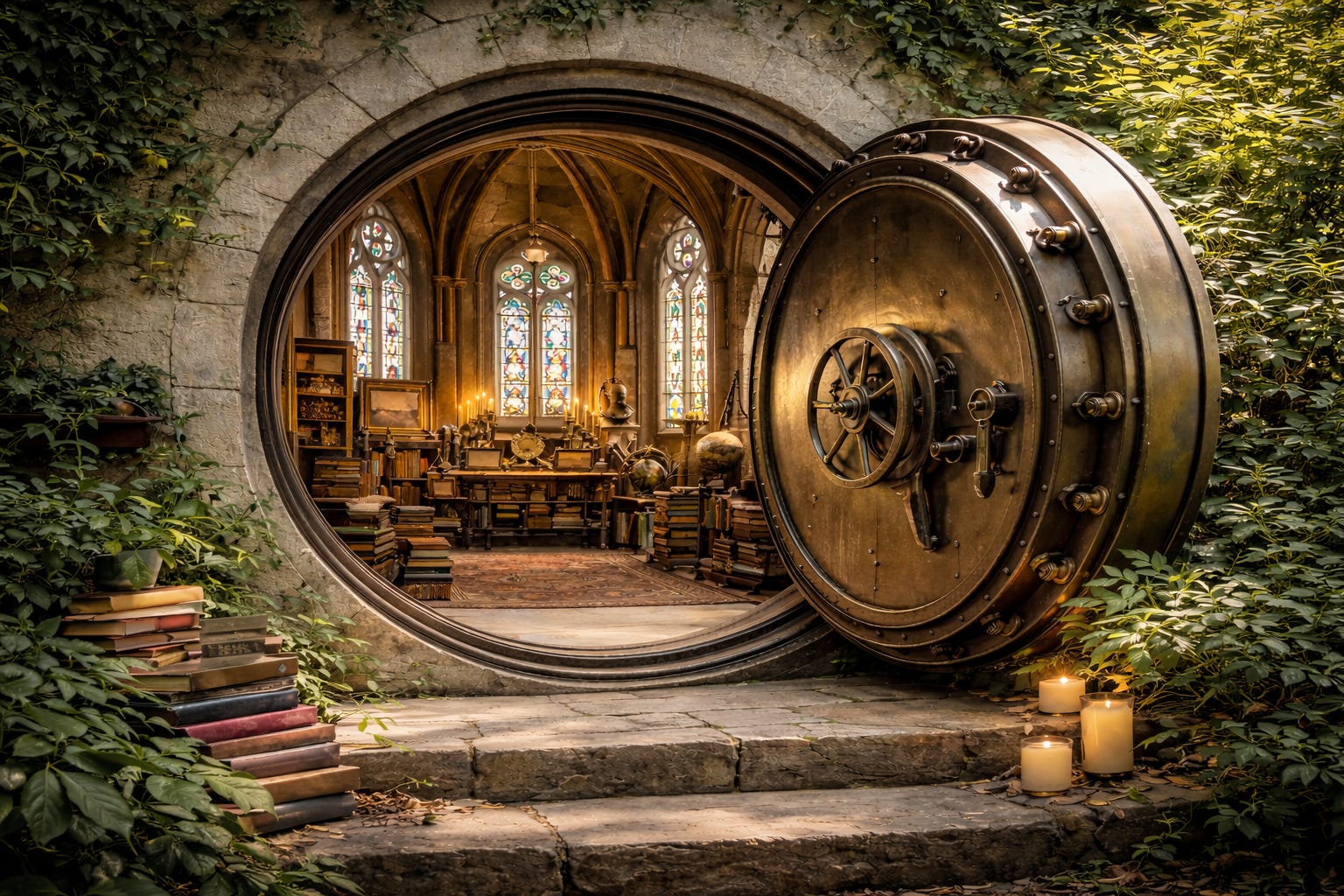
Imagine your interior landscape as having a private vault. This is the place for the thoughts that are too complex to caption. This is where you keep the art that does not require an audience to be valid.
The fear that feels ancient and heavy.
The intuitive knowing that defies logic.
The compelling and detailed understanding of a subject that the rest of the world may not find interesting.
When you choose to keep these things in the vault, you are not suppressing them. You are savoring them. You are recognizing that their value is intrinsic, not social. They do not need to be liked or understood to be worthy of honoring.
The Autonomy of Your Own Perception
There is a discipline in letting an image, or an emotion, exist without intrusion. As a docent might stand back to let a viewer encounter a painting on their own terms, you can learn to stand back and let your own deepest self exist without needing to explain it to the gathered crowd.
When you stop trying to make everyone else understand your internal world, a shift occurs. The energy you previously spent on captioning your life returns to you. The loneliness transforms into solitude, which is a place of rest and restoration.
The silence around your deepest treasures stops feeling like an empty room. It begins to feel like a cathedral. It is quiet not because no one is there, but because the space is sacred.
A Note on the Text If this piece resonated with you, I invite you to subscribe to Untangling Chaos. Here, we explore the complexities of relationship, the autonomy of perception, and the quiet dignity of the inner life in a world that seldom seems to value the slower pace required for reflection.
A very prescient post, thank you.