
The Algorithmic Sophist
What happens when persuasion is automated

There is a moment, now common enough to feel ordinary, when you realize you are reacting before you have thought. A headline appears, a sentence flashes past, and your body tightens as if something urgent has happened. Only afterward do you notice that nothing in your physical surroundings has changed. The stimulus was informational, but the reaction was physiological.
Many people interpret this as personal fatigue or declining attention, but it is neither. It is the sensation of living inside an environment designed to eliminate the pause between perception and response.
What is disappearing is not information, but distance.
You feel it as a subtle exhaustion. It’s not the exhaustion of ignorance, but of constant activation. The interval that once allowed reflection, doubt, or reconsideration has grown thin. Reaction arrives faster than understanding.
Something fundamental in public life has shifted. We still speak constantly, argue constantly, and consume an endless stream of opinion, yet the shared space required for thinking together has become harder to find. The problem is not disagreement because Democracies have always depended on disagreement. The problem is that the clearing in which disagreement once occurred is quietly disappearing.
To understand this feeling, it helps to leave the present for a moment and walk into another democracy at the height of its confidence.
Athens before the noise
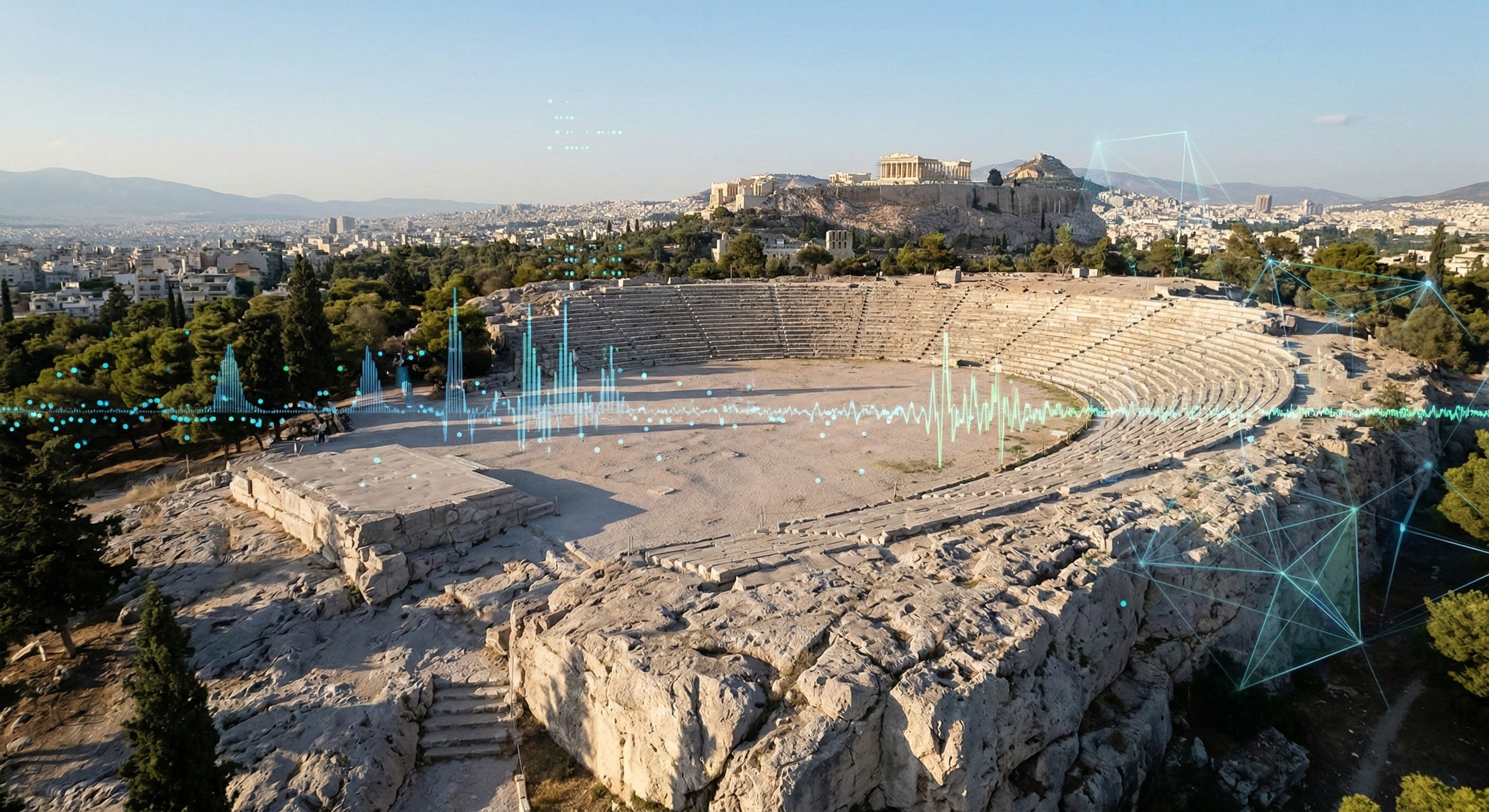
In fifth-century BCE Athens, citizens gathered on a rocky hill called the Pnyx. From this open space they debated war, law, leadership, and the fate of their polis. For the Greeks, Democracy was not an abstraction. It was a physical gathering in shared air.
Speech mattered because speech decided reality.
During this same period, a new class of teachers appeared in the city. Later generations would call them Sophists. Figures such as Protagoras and Gorgias taught young Athenians how to argue persuasively in courts and assemblies. They were skilled, innovative, and controversial. They accepted payment for teaching rhetoric, something many citizens found unsettling.
The comic playwright Aristophanes watched these changes with alarm.
In his satire Clouds, he imagined a world in which argument itself had detached from lived reality, where clever speech could make the “worse argument” appear the better. His concern was not merely intellectual. It was civic. If persuasion became more powerful than shared truth, what would happen to democracy itself?
Aristophanes was not offering a neutral description. He was expressing a fear that public life could be hollowed out not by silence, but by increasingly effective speech.
Athens had not lost its voices. The Sophists persisted. But Athens had lost its grounding.
When persuasion becomes architecture
The Athenians worried that rhetoric might overpower judgment.
We face a different version of the same structural problem.
Today, persuasion no longer arrives only through speakers standing before citizens. It operates invisibly through systems designed to measure attention. In this sense, the Sophist has not disappeared. It has been automated.
The new rhetoric is the metric.
An online post gains authority because it generates engagement. A claim spreads because it produces reaction. Visibility becomes indistinguishable from validity. What rises is not what is most accurate or most wise, but what most efficiently captures the nervous system of the most individuals.
In ancient Athens, rhetorical skill amplified the ambitious speaker. In contemporary America, algorithms amplify whatever produces measurable emotional activation.
The effect is similar. The “worse argument” gains structural advantage, not because citizens are foolish, but because outrage travels faster than reflection.
The demagogue without a face
Aristophanes reserved special hostility for the populist leader Cleon, whom he mocked in Knights as a figure who governed through agitation rather than guidance. Cleon’s power rested on immediacy. He collapsed the distance between fear and response.
Modern demagogues do not always look like politicians. Many appear as entertainers, influencers, commentators, or anonymous accounts optimized for visibility.
Their success depends on maintaining attention through continuous emotional stimulation. Shock replaces persuasion. Reaction replaces deliberation.
The goal is retention, not agreement. Not understanding.
What changes under these conditions is the rhythm of perception itself. The digital environment reduces latency, which is the time between stimulus and emotional response. A reactive population becomes predictable, and predictability becomes profitable. Polls guide politics.
You are no longer standing in an agora, where conversations were interpersonal. You are moving through a feedback system.
The thinning of the clearing
Democracy requires more than speech. Humans are capable of thought, and thought requires interval.
The ancient assembly worked because citizens encountered one another within a shared temporal space. Arguments unfolded slowly enough for reconsideration. Presence imposed limits on escalation, in stark contrast to the rapid explosion possible in a virtual environment where no one is looking into anyone else’s eyes.
Digital environments remove those limits. The argument never ends because the system rewards continuation. The nervous system never settles because novelty is constant. One result of this is that it becomes difficult these days to define anxiety in any meaningful way.
The result feels strangely personal. The arrival of new information outpaces our ability to digest it. Many people conclude they are failing to keep up, failing to stay informed, failing to remain calm.
But the exhaustion is structural. It didn’t originate within you.
You are experiencing what happens when a culture loses the gap between experience and reaction.
The insight: latency is not weakness
The most important shift in perspective may be this:
You are not struggling because the world has become too complex. You are struggling because the environment is designed to eliminate pause.
Latency, the pause that allows responding to replace reacting, is not indecision. It is the condition that makes thought possible.
Insight arrives only in that interval.
Algorithms can map preferences, predict clicks, and model behavior. What they cannot model is silence, the moment in which a person chooses not to respond according to expectation.
That space remains human.
A concrete practice
The recovery of the clearing begins physiologically. Counterintuitively, perhaps, it does not begin with reforming technology or persuading millions of strangers.
The next time a digital argument produces a contraction, heat in the neck, tightening in the chest, the impulse to reply, do something structurally different.
Look away from the screen.
Find one living element nearby: a leaf, a tree, a plant on a windowsill. Observe it closely for three slow breaths. Notice texture, asymmetry, growth.
This small act reintroduces biological time into an artificial rhythm. It restores latency to a system designed to erase it.
You are not escaping reality. You are reentering it.
The non-resolving conclusion
Aristophanes did not solve Athens’ problems. His plays ended in recognition rather than repair. The city continued toward conflict despite its brilliance.
We should not expect a clean resolution to our own moment. The metric will continue to govern visibility. The algorithm will continue to reward reaction.
But one clarity remains available.
The impasse is inherent in the system, not in your mind.
The democratic clearing does not survive because technology permits it. It survives wherever a person preserves the space between stimulus and soul.
It is a small space.
It is also the only place from which genuine thought, and genuine freedom, can begin.