
Not Just Envy, Erasure
Why Donald Trump can't stand Barack Obama

Hostility toward a rival does not always arise from the same wound. The outward signs may look similar: fixation, contempt, repeated attack, refusal to let the other man stand without challenge. But the inward structure can differ sharply, and that difference shapes what follows.
The wrong man enthroned
Arthur Schopenhauer and G. W. F. Hegel came to represent opposing visions of philosophy in nineteenth-century Germany. Hegel stood near the center of academic prestige. His work carried institutional authority and public weight. Schopenhauer saw in him not greatness but inflation: abstraction protected by institutions and rewarded beyond its merit. He regarded himself as the more substantial thinker, and Hegel’s prominence appeared to him not as a difficult fact of intellectual life but as a scandal of misplaced recognition.
One kind of rivalry takes shape there. The wound begins in the conviction that honor has attached itself to the wrong man. The rival’s success then confirms a broader indictment of the surrounding world. The audience has poor judgment. Institutions reward obscurity. Culture mistakes scale for substance. Hatred of the rival widens into contempt for the order that elevated him. The offense was not that Hegel had surpassed Schopenhauer, but that a man Schopenhauer considered inferior had come to stand publicly for philosophy.
The attack on legitimacy
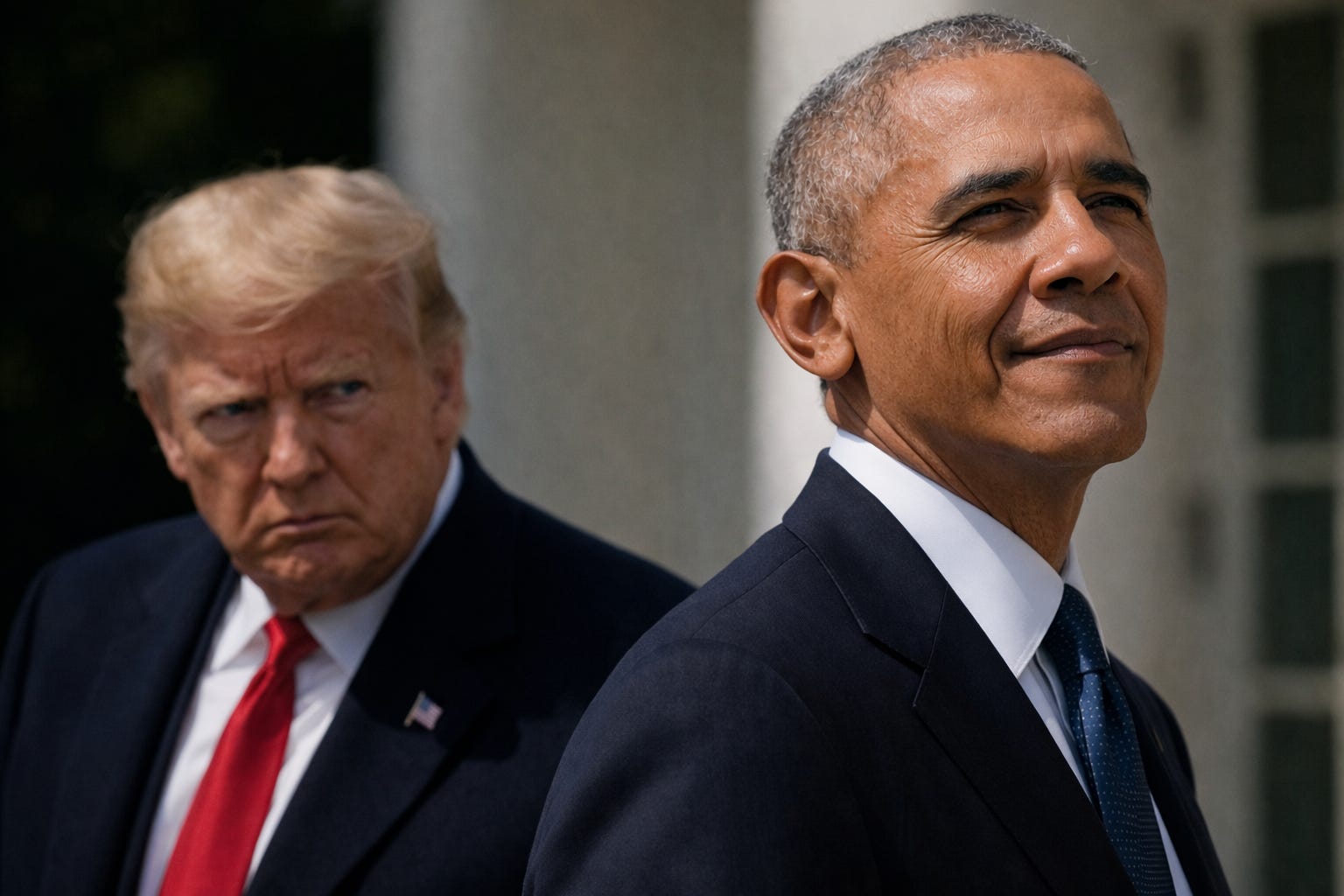
Donald Trump’s relation to Barack Obama arises from a different wound. Here the pressure does not begin in the spectacle of an inferior man wrongly elevated. It begins in the presence of a rival whose visible stature he cannot endure. Obama occupied the office with an ease and legitimacy Trump cannot comfortably tolerate. The hostility therefore moves beneath ordinary political antagonism. It presses downward toward delegitimation.
Trump’s birtherism arises not from genuine uncertainty about Obama’s birthplace, but from a deliberate effort to stain his legitimacy at the source. It is not about whether Obama governs well or badly. It reaches beneath policy and seeks to contaminate his right to occupy the office and therefore also his right to be recognized as fully belonging where he is. Once an attack moves to that level, the goal has changed. The rival is no longer merely opposed. His public reality is placed under erasure.
A man who believes the wrong rival has been elevated directs resentment toward false prestige. He condemns bad judgment, institutional weakness, and a public that admires what does not deserve admiration. A man who cannot endure another man’s visible stature goes further. He turns against the conditions by which stature is conferred and sustained. Recognition becomes intolerable. Legitimacy offends him. Esteem held in the hands of others becomes something he must stain.
The injury does not remain confined to the rival. It spreads into the larger world of value around him. Whatever others trust, admire, or hold together in common begins to attract hostility. Trump’s attacks therefore extend beyond particular opponents to institutions, standards, and public trust itself. The impulse has its own logic. If another man’s stature has become unbearable, then the world that confirms that stature becomes unbearable as well. Institutions, norms, and public goods become targets because they participate in a reality outside the self, a reality that confirms worth one does not command. The damage spreads outward from there. Trust must be weakened. Standards must be blurred. Public authority must be made doubtful. Shared reality itself becomes something to foul.
The political danger does not stop with the degradation of one rival. A country is trained to live amid contamination. Citizens learn to distrust institutions, to treat standards as masks for manipulation, and to experience legitimacy itself as fraud unless it serves the leader’s need. The result is not only polarization, but corrosion of the shared world on which democratic life depends. Public language loses credibility. Common judgment weakens. The possibility of honoring competence, dignity, or lawful authority without suspicion begins to erode. Hostility toward one man becomes hostility toward the conditions under which a nation can recognize anything higher than appetite, grievance, and force.
Admiration bound to pain
Antonio Salieri and Wolfgang Amadeus Mozart mark a third structure, though the example reaches us through cultural imagination as much as through settled history. In the familiar formulation, Salieri suffers not because the lesser man has been wrongly exalted, but because he recognizes the greatness of the other and cannot bear what that recognition does to him. His pain lies in seeing excellence clearly, admiring it, and suffering under it at the same time. That differs from Schopenhauer’s contempt for falsely rewarded mediocrity, and from the more destructive inability to tolerate a rival whose public stature exposes one’s own insufficiency. It belongs to the same human territory, but its texture is different. Admiration and resentment remain bound together.
When rivalry turns corrosive
Schopenhauer cannot bear the public elevation of a man he considers inferior. Salieri suffers before a gift he recognizes as real but cannot equal. Trump cannot bear a world in which another man’s superiority stands in public view. In the first case, resentment fixes on false prestige. In the second, admiration becomes inseparable from pain. In the third, hostility widens into an attack on the conditions under which legitimacy and standing are publicly recognized.
At that point rivalry has become something darker. The attack is no longer confined to the rival himself. It extends to recognition, legitimacy, and the shared standards by which worth is judged and honored. What comes under pressure is not only one man’s standing, but the public conditions under which dignity, authority, and esteem can be recognized at all.
Thank you for this great read! And sadly I have to say for your courage. I shouldn't have to say that part but your article explains why I say it.